
Why 'Done Lists' Are More Powerful Than To-Do Lists for Building Momentum
Discover the psychology behind done lists and how they outperform todo lists for building momentum, reducing procrastination, and boosting confidence through dopamine rewards.
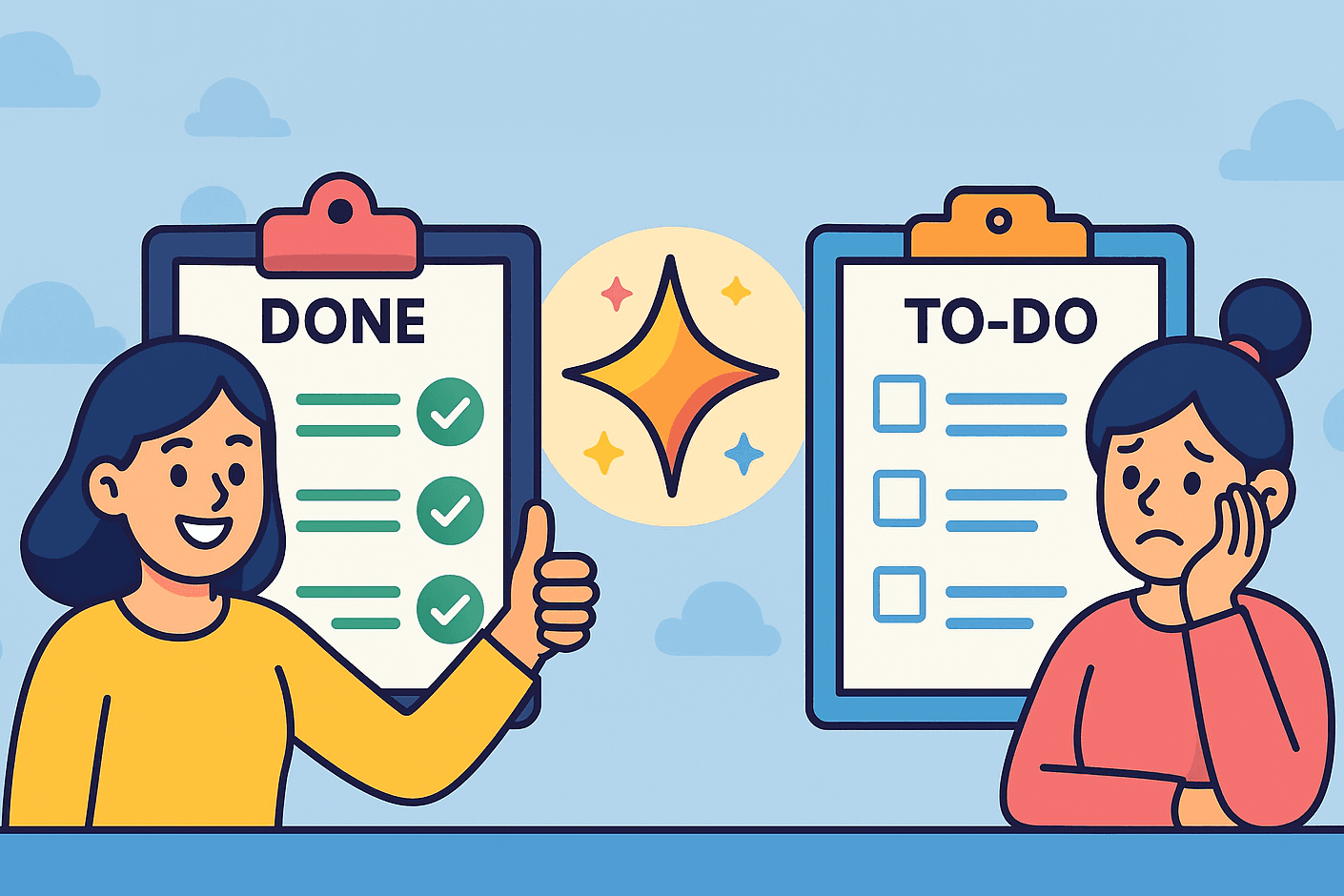
You've probably tried countless productivity systems, apps, and techniques to get more done. But here's a counterintuitive truth: focusing on what you've already accomplished might be more powerful than obsessing over what you still need to do.
Welcome to the psychology of 'done lists'—a simple yet scientifically-backed approach that's revolutionizing how we think about productivity, momentum, and personal achievement. Let's explore why your brain responds better to celebrating completion than planning tasks.
The Hidden Problem with To-Do Lists
According to research published in "The Busy Person's Guide to the Done List" by Bailey Adams, 41% of all items on a person's to-do list are never completed. Even more striking: only 10% of tasks are completed within a minute of being added to the list.
This isn't just poor planning—it's a fundamental misunderstanding of how our brains work. To-do lists create what psychologists call "cognitive burden," constantly reminding us of unfinished tasks and creating mental stress even when we're trying to relax.
The Zeigarnik Effect: Why Unfinished Tasks Haunt Us
The Zeigarnik Effect, discovered by Lithuanian psychologist Bluma Zeigarnik in 1927, reveals that our brains are wired to remember unfinished tasks better than completed ones. This creates what researchers call "cognitive tension"—a persistent mental burden that consumes cognitive resources until the task is resolved.
Research by Roy Baumeister and EJ Masicampo at Florida State University found that people performed worse on brainstorming tasks when they were prevented from finishing a simple warm-up task—because the unfinished task was stuck in their active memory, draining mental resources.
Enter the 'Done List': A Neurological Game-Changer
A done list is exactly what it sounds like: a record of tasks you've completed. But don't let its simplicity fool you—this approach leverages powerful neurological mechanisms that traditional to-do lists ignore.
The Dopamine Reward System
Harvard Medical School research shows that completing tasks triggers dopamine release—the neurotransmitter responsible for motivation, pleasure, and reward. Dr. Ralph Ryback, former Harvard Medical School professor, found that "the satisfaction of ticking off a small task is linked with a flood of dopamine."
This isn't just about feeling good. Recent NIH research demonstrates that dopamine actually changes how your brain evaluates future tasks, making challenges seem more manageable and rewarding. Each completed task creates a positive feedback loop that makes you more likely to tackle the next one.
The Momentum Effect
Research on psychological momentum shows that sequential runs of success create sustained high performance. When you see a growing list of completed tasks, your brain interprets this as evidence of your capability, creating what psychologists call "efficacy expectations"—your belief that you can handle future challenges.
Harvard's Progress Principle: The Science of Small Wins
Professor Teresa Amabile's groundbreaking research at Harvard Business School analyzed over 12,000 diary entries from knowledge workers to understand what truly drives motivation. Her findings, published in "The Progress Principle," revealed something remarkable:
"Nothing contributed more to a positive inner work life than making progress in meaningful work. Forward momentum in meaningful work—progress—creates the best inner work lives."
The key insight: people were happiest and most productive when they could see evidence of their progress—even if that progress consisted of small, incremental wins. This is exactly what done lists provide: tangible proof of forward momentum.
The Procrastination Connection
Recent research reveals procrastination affects 80-95% of college students and 20-25% of adults chronically. But here's what's interesting: 2025 research shows that academic self-efficacy—your belief in your ability to succeed—is one of the strongest predictors of whether someone will procrastinate.
Done lists build self-efficacy by providing concrete evidence of your capabilities. Each completed task becomes what psychologist Albert Bandura called a "mastery experience"—the most powerful source of confidence in your abilities.
Breaking the Procrastination Cycle
The Zeigarnik Effect explains why we procrastinate: unfinished tasks create cognitive tension that our brains try to avoid. But done lists flip this script. Instead of being reminded of what you haven't done, you're constantly reinforced by what you have accomplished.
Research shows that tracking accomplishments creates positive reinforcement loops that increase motivation. The more you see evidence of your productivity, the more productive you become.
The Neurochemical Cocktail of Achievement
Done lists don't just trigger dopamine—they activate a complex neurochemical system that supports sustained motivation:
- Dopamine: Provides immediate reward and increases motivation for future tasks
- Serotonin: Improves mood and confidence levels
- Endorphins: Create feelings of well-being and reduce stress
- Norepinephrine: Enhances focus and attention
2024 research from Mount Sinai using advanced brain measurement techniques found that dopamine levels increase when people see evidence of progress, creating a biological basis for why done lists feel so rewarding.
Practical Applications: How to Build Your Done List Practice
1. Start Micro
Begin by recording the smallest possible accomplishments: "Made coffee," "Sent that email," "Organized my desk." The size doesn't matter—what matters is training your brain to notice and celebrate completion.
2. Use the 20-Second Rule
Research shows that positive experiences need at least 20 seconds of focused attention to transfer from short-term to long-term memory. When you add something to your done list, take a moment to truly savor the accomplishment.
3. Create Categories
Organize your done list by life areas (work, health, relationships, personal growth). This builds domain-specific confidence and helps you see progress across different aspects of your life.
4. Review Regularly
Set aside time weekly to review your done list. This reinforces the neural pathways associated with achievement and helps you recognize patterns in your productivity.
The Victory App: Done Lists in Action
This research is precisely why Victory was designed as a done list app rather than a traditional to-do list. Every feature is built around the psychology of completion:
- Daily victory logging: Captures mastery experiences as they happen
- Streak tracking: Visualizes momentum and progress over time
- Category system: Builds domain-specific confidence
- Level progression: Gamifies the neurochemical rewards of achievement
- Visual progress: Provides concrete evidence of growth
By focusing on what you've accomplished rather than what you haven't, Victory leverages the same psychological mechanisms that Harvard researchers found drive the highest levels of motivation and performance.
The Compound Effect: Small Wins, Big Changes
The most powerful aspect of done lists isn't any single entry—it's the cumulative effect. Each completed task:
- Releases dopamine, making you more motivated for the next task
- Builds self-efficacy through mastery experiences
- Creates positive momentum that carries forward
- Reduces the cognitive burden of unfinished tasks
- Provides evidence that counters procrastination patterns
Over time, this creates what researchers call a "confidence spiral"—each success makes the next success more likely, building unstoppable momentum.
Your Done List Challenge
Ready to experience the psychological power of done lists? Here's a science-backed 30-day challenge:
The 30-Day Done List Experiment
- Week 1: Record 3 small accomplishments daily (focus on consistency)
- Week 2: Add categories and note how different areas make you feel
- Week 3: Include slightly larger accomplishments alongside small ones
- Week 4: Review your progress and notice changes in motivation
Track your motivation levels daily (1-10 scale). Research predicts you'll see measurable improvements in both productivity and well-being.
Start with Victory App→The Psychology is Clear
From the Zeigarnik Effect to Harvard's Progress Principle to the latest neuroscience on dopamine and motivation, the evidence is overwhelming: focusing on completion rather than planning creates better psychological outcomes.
Done lists aren't just a productivity hack—they're a scientifically-validated approach to building momentum, reducing procrastination, and creating the neurochemical conditions for sustained motivation.
The question isn't whether this approach works. The question is: are you ready to flip the script on productivity and start celebrating what you've already accomplished?
Joseph Paris
Creator of Victory App • Based on research from Harvard, Stanford, NIH & Florida State